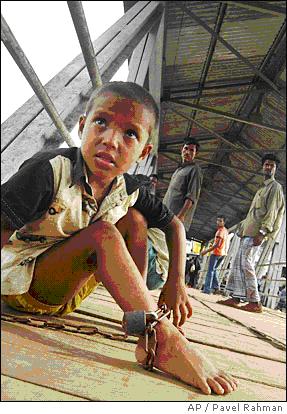
Locked to a dock: Every day before she sets out to look for menial jobs, Ayesha's mother chains the 5-year-old to a ferry terminal in Dhaka, Bangladesh. She's afraid the girl might get lost or kidnapped while she's gone.
Editor's Note: Here's an extract from Santhanam's article - Remembering Deepu and Sriram in the October 2002 Newsletter. "....What shocked me (and amused me) about his (Deepu's) childhood is that he was tied everyday by a rope to the window when my sister Pushpa left for office because his grandmother found it very difficult to manage him. He bore this ordeal without complaint and one day, when his mother, in a hurry to leave for office forgot to tie him up, the 3-year old Deepu reminded her, " Amma, ennai katti podalaiye". No wonder my sister was moved to tears."
This photo and its accompanying caption have haunted me ever since I first came across them a month and a half ago.
I think of Ayesha’s mother oftentimes. It must be more difficult for her to do the daily chaining than even for her little daughter to endure it. The mother must have agonized for days and sleepless nights about what would happen to her daughter during the hours she went looking for work. I am still trying to come to grips with the fact that we live in a world where a mother’s fears that her daughter would get kidnapped are so real that she has concluded that shackling her 5-year old is the best option.
As the mother goes on doing her day’s work, I imagine the mother glancing at the key and being reminded of her daughter back in the ferry terminal. At the end of a hard day’s work, I picture her hurrying back to her eager, immobilized daughter. And again, the very next morning, having to chain down her own daughter and walking away, hoping to land some work that day, hurrying away without bearing to her turn back to glance at her little girl.
I often think of the little girl. While the other kids her age get to play with friends and run around freely, 5-year old Ayesha gets chained down to the same spot for 9 or 10 hours every day. I wonder if she has to shout for someone to give her some water when she’s thirsty, food when she’s hungry. I feel bad that she isn’t even afforded the simple privacy of a toilet during the entire day.
I think of what would happen if the wooden ferry bridge caught fire. Over many days, I have thought of a dozen worst-case scenarios, things that can go wrong if you chain someone to a spot and go away. I hope and pray that the mother has given a spare key to someone nearby whom she trusts.
A dozen years hence, when little Ayesha grows into a young woman, I wonder what kind of an impression this daily experience would leave on her psyche. I am not sure if the scars caused by certain experiences ever heal.
I look at Ayesha’s expression on the photograph, her eyes big and curious. I imagine her face breaking into a big smile when she spots her mother returning late in the evening. I wonder if Ayesha sometimes worries that her mother may never come back to the terminal to unlock her. The little girl must want to believe that her mother is only doing this “for her own safety” and yet wonder why her mother has to chain her and go away for so long every day.
Every night, here in Chicago, I make myself a cup of tea a couple of hours after dinner. Ever since I made the connection, it is while waiting for the water to boil that I usually think of the photograph. After many years of telephoning India, I am as aware of the current time in India as I am of the local time in Chicago. Dhaka is 8000 miles away from Chicago, but only 30 minutes ahead of Indian Standard Time. If it is time for my night tea, I know that it is that time of the morning in Dhaka. It is the time for the two of them to start the day, for little Ayesha and her mother to walk solemnly toward the ferry terminal bridge.
Ram Prasad
July 2006